
Oak Ridge ground
Tree Pests and Disease in Oak Ridge, TN
Short answer
The pests that kill yard trees around Oak Ridge are emerald ash borer, confirmed in Anderson and Roane counties in 2012 and able to kill an ash within three years; southern pine beetle, which hit East Tennessee pines hard around 1993 and again around 2000; hemlock woolly adelgid, which kills hemlocks in 3 to 10 years; and thousand cankers disease of black walnut, reported in the city of Oak Ridge. A dead ash or pine next to a house turns from a pest problem into a removal job.
One independent local contractor can look at a declining tree and tell you whether it's a trim, a treatment question or a takedown.
Is emerald ash borer in Oak Ridge?
Yes. The Tennessee Department of Agriculture expanded its emerald ash borer quarantine to Anderson, Roane, Hamblen, Hancock and Hawkins counties on May 18, 2012, after the beetle was found there, and said: "Typically, the Emerald Ash Borer beetles can kill an ash tree within three years of the initial infestation" (TDA, May 18, 2012). The first Tennessee find had come in 2010 at a truck stop in Knox County near the Loudon County line (TDA, July 27, 2010).
On the Oak Ridge Reservation, the beetle turned up in traps near the national laboratory, and its grounds manager estimated "about 100,000 ash trees on the property," with ash making up "around 4 percent of the trees on the managed landscape." The lab's article was blunt about the risk: "Dead trees or branches have the potential to fall on passersby or damage power lines" (ORNL, "Hardwoods in peril," Oct. 2, 2014).
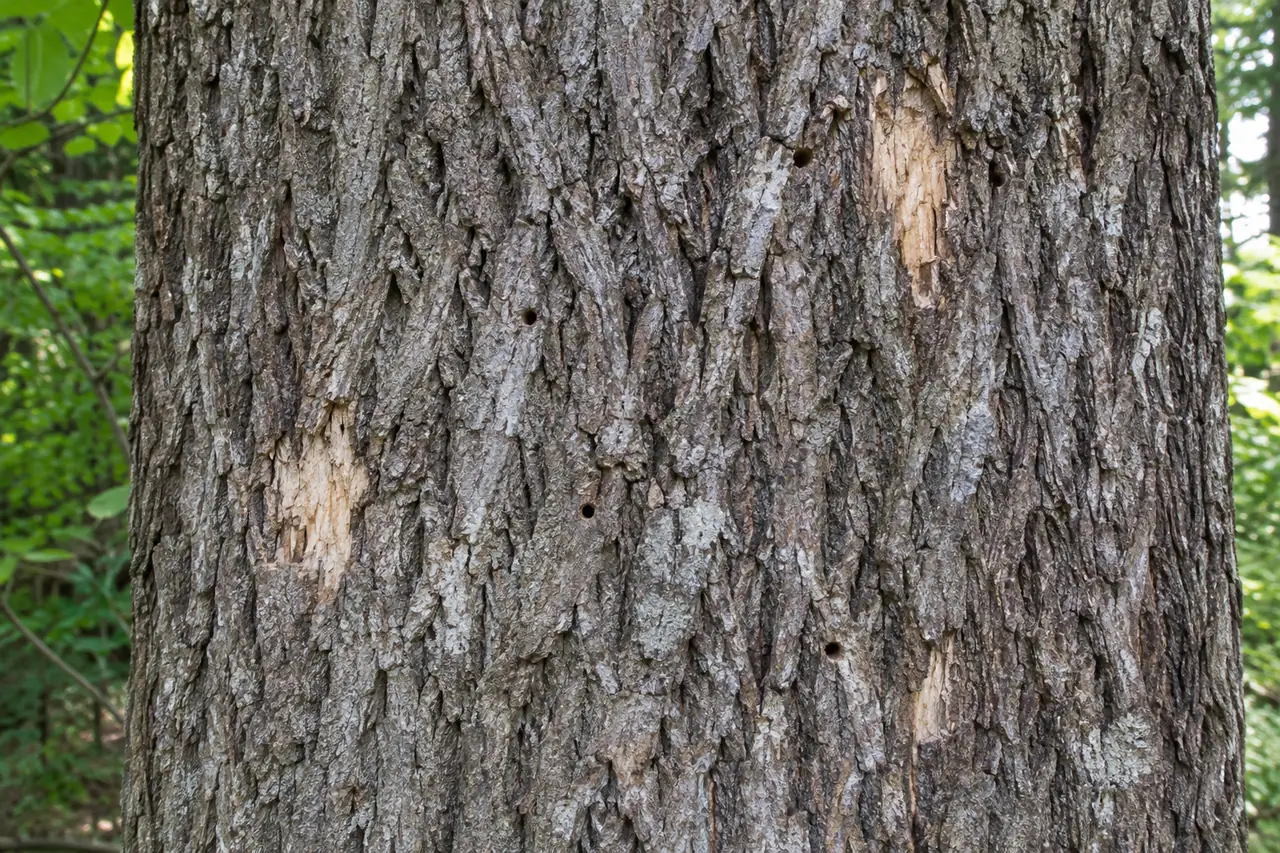
Signs. The larvae spend most of the year beneath the bark, and the adults leave D-shaped exit holes about an eighth of an inch wide as they emerge (TDA, 2010).
Firewood. The state's standing advice when ash borer reached this area: "Don't transport firewood, even within Tennessee," and "Get the wood you need from a local source" (TDA, 2012). When an ash comes down, keep its wood on the property or close by.
What about southern pine beetle?
The Tennessee Division of Forestry calls it "one of the most widespread and destructive insect pests of pine," and lists "Loblolly, shortleaf, pitch, pond, and Virginia pines" as the favored hosts. Tennessee's last big outbreak "gradually built to outbreak levels in 1998" and "killed approximately 350,000 acres and $358 million of pine in the succeeding years"; populations have declined since 2003 (Tennessee Division of Forestry, checked Nov 22, 2026). In 2001, 70 Tennessee counties had beetle activity and 58 were in outbreak, and the yellow pine in several eastern counties was cut by more than half (Tennessee Forest Health Highlights 2001, USDA Forest Service).
Oak Ridge saw it up close. The national laboratory's grounds manager first came to the lab to manage southern pine beetle damage, and the beetles devastated the region's yellow pines in 1993 and again around the turn of the millennium (ORNL, 2014).
Signs, from the Division of Forestry: "pitch tubes along the trunk on the outside of the bark"; a crown that begins "to fade, turn red or needles fall off"; small round exit holes; and S-shaped tunnels under loose bark. The division explains that the crown change follows once the beetles' galleries girdle the tree. The division's options for infested stands include "cut & remove" and "cut & leave," and it asks that suspected activity be reported to a county agent, a forester or the Division of Forestry (Tennessee Division of Forestry, checked Nov 22, 2026).
Are the hemlocks in Oak Ridge ravines dying?
Many are under attack. Hemlock woolly adelgid is "a small, aphid-like insect that threatens the health and sustainability of eastern hemlock." Since it was detected in Tennessee in 2002, it "has spread to 43 counties in East Tennessee and the Cumberland Plateau," and infested trees die "within 3 to 10 years," 3 to 6 years in the southern part of the range (Tennessee Division of Forestry, checked Nov 22, 2026). In 2014, the national laboratory reported that "the reservation is struggling with hemlock woolly adelgid now" (ORNL, 2014).
Signs. Look for white, woolly egg sacs "on the underside of the outermost branch tips," easiest to see from late fall to early summer, then gray, thinning foliage. Positive identification on the foliage is needed, because other problems look similar.
Treatment. A hemlock that still holds most of its needles can be protected. The division says soil injection or soil drench is the most common method, that "Imidacloprid and dinotefuran are the most effective chemical types," and that a treatment typically lasts up to five years (Tennessee Division of Forestry, checked Nov 22, 2026). A hemlock that is already mostly gray is a removal question, especially over a house.
Black walnut and thousand cankers disease
Thousand cankers disease, which afflicts black walnut, was reported detected in the city of Oak Ridge by 2014 (ORNL, 2014). A declining black walnut is worth having looked at before it is pruned or its wood is moved as firewood.
What else has hit trees here?
- Dogwood anthracnose. In 2001 it was found in 59 counties in the eastern half of Tennessee, and a 1998 survey of plots in infected counties found 49 percent of dogwoods dead (Tennessee Forest Health Highlights 2001).
- Oak decline after drought. The same report said the 1998 to 2001 drought kept raising oak mortality, mainly red oaks, in all four of the state's major regions.
- Gypsy moth. Now called spongy moth, it was detected at 47 locations statewide in 2001, and spraying of over 8,500 acres in neighboring Campbell County was proposed for 2002 (Tennessee Forest Health Highlights 2001).
- Bacterial leaf scorch. The national laboratory's campus has had it too (ORNL, 2014).
When does a sick tree have to come down?
When it is dead or dying and could reach something that matters: the house, the drive, a play set, the street or a line. Dead ash and beetle-killed pine are the usual cases. There's also a legal reason in Oak Ridge: under City Code §13-405, the city can require an owner to remove dead or diseased trees on private property that harbor insects or disease threatening other trees in the city, within 60 days of written notice, and can do the work itself and place a lien on the property if the owner doesn't (Oak Ridge City Code, Title 13, checked Nov 22, 2026).
Dead trees are harder and riskier to take apart than live ones, because the wood breaks in ways a climber can't predict. That is one reason to deal with a dying ash while it still has some live wood in it. The removal page covers how it's done.